Electrical components in India go out of stock in a predictable order: variants and accessories first, main devices later, with pressure peaking around financial year end and the pre-monsoon construction push. Most shortages buyers meet are local or seasonal rather than market-wide, so the fix is ordering accessories with their devices and placing confirmed orders ahead of the peaks.
What a stock-out is, and what it is not
“Out of stock” covers several different situations, and the right response depends on which one you are facing.
Four kinds of unavailability, and what to do about each
| Situation | What it means | What to do |
|---|---|---|
| Seller stock-out | This seller cannot supply the line today | Ask other sellers and distributors; the item may be on a shelf nearby |
| Channel shortage | Distributors in your region are short | Ask about the maker's regional stock, or accept indent with a firm date |
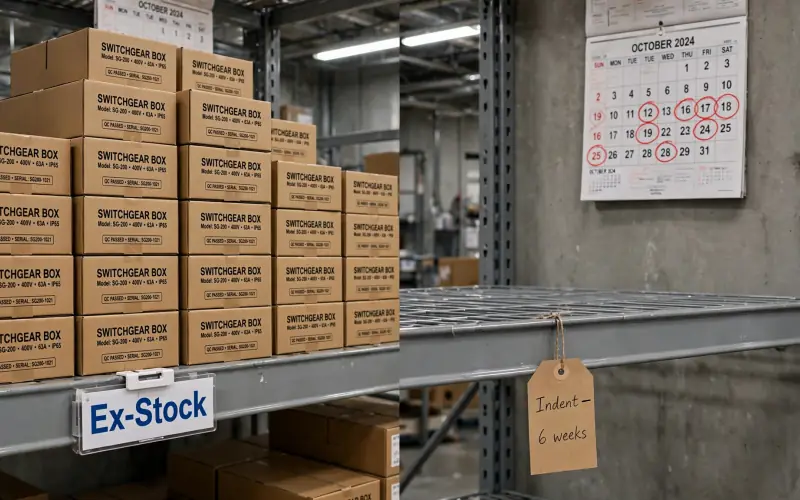
| Factory indent | The line is made or configured to order | Order early and plan to the factory's schedule |
| Market-wide shortage | The maker cannot supply in volume | Consider an approved equivalent, after the checks a substitution needs |
This post describes patterns across our own catalogue, sampled on a fixed schedule, and what the trade commonly sees. It is not a measurement of the Indian market as a whole: a line that is tight on our listings may be sitting in a distributor's godown down the road.
We say that plainly because, in our view, a stock-out report that claims to describe the whole market is overclaiming, and a buyer who plans on it will chase shortages that do not exist.
Why variants and accessories run out first
Main devices in popular ratings are the most stocked items in the channel: distributors hold them deep because they sell every week. Availability thins out quickly as you move away from the popular configuration:
- four-pole versions of breakers normally sold as three-pole;
- contactor coils at less common voltages, such as 415 V AC or 24 V DC on ranges usually stocked at 230 V AC;
- shunt trips, undervoltage releases, auxiliary contacts, rotary handles and motor operators;
- particular CT ratios and burdens, and meters with particular communication options;
- terminal block accessories such as end plates, jumpers and the right marker strips.
Buyers make this worse by ordering the main devices early, when the project is approved, and the accessories at wiring stage, weeks later, when the schematic is finally checked. By then the accessory has become the critical path. The breaker sits on site; the panel waits for a part that costs a fraction of it.
In our view the most useful change a buyer can make is also the simplest: order every accessory and variant on the same purchase order as its device.
Why accessories get ordered late, and how to fix it
The late accessory is rarely carelessness. It is built into how many projects create their bill of materials:
- The first bill of materials comes from the single-line diagram, which shows breakers, ratings and feeders, and not the shunt trips, auxiliary contacts and coils that appear only in the control schematics.
- The control schematics come later, from the panel builder, after the main devices have already been ordered against the first list.
- Accessories are small and cheap, so nobody chases them until wiring stops for want of one.
The fix is procedural. Ask the panel builder for an accessory schedule — every shunt trip, release, contact, handle and coil, per device — at drawing approval, and order it as one list against the devices it belongs to. Our post on the most common switchgear ordering errors treats accessory omission as one of the eight errors for this reason.
Seasonal pressure points in India
Demand for electrical components is not flat through the year. Several recurring periods put pressure on channel stock and on dispatch queues:
Recurring periods of pressure on electrical component availability in India
| Period | What happens | How to respond |
|---|---|---|
| Financial year end, January to March | Projects rush to complete and budgets are spent before 31 March, lifting demand across categories | Place confirmed orders before January, especially indent lines |
| Pre-monsoon, April to June | Construction and outdoor electrical work peak before the rains | Secure cable, distribution and protection items early for site work |
| Monsoon, July to September | Heavy rain disrupts transport and site deliveries in many regions | Allow extra transit time and confirm delivery access |
| Festival season, October to November | Production and transport slow around Diwali as workforces take leave | Avoid planning critical dispatches in festival weeks |
| Ahead of a price revision | Buyers pull orders forward before an announced increase | Expect short-term tightness on fast-moving lines |
Timing varies by region and by year, and none of these periods guarantees a shortage. They are the times when a line that is usually easy to find can take longer. For the last row, see our post on switchgear price increases.
Our own record shows the same two peaks, year end and pre-monsoon, and in both we were short on lines we should have been holding. A season explains a shortage; it does not excuse one.
Which categories are structurally tight
Some categories are tight because of how they are made and sold, whatever the season:
- Air circuit breakers and high-frame MCCBs. Built or configured to order, with thin channel stock. Plan them as indent lines.
- Motorised, drawout and special-release variants. Configured at the factory, or assembled from accessories that are themselves stocked thin.
- Electronics. Meters, numerical relays and electronic releases depend on component supply, which can tighten independently of the rest of the market.
- Made-to-order assemblies. APFC panels, custom distribution boards and LT panels are built per order and have no stock to run out of; their lead time is the build.
- Commodity lines. Popular MCB ratings, standard contactors and common cable sizes are usually available from someone, but their prices move quickly with metal costs.
Treat this list as the questions to ask before you order, not as a forecast: whether a category is tight in your region this season is something only a current stock check can tell you.
What a shortage does to prices and quotations
When a line is tight, the change shows up in quotations before it shows up as an empty shelf:
- Discounts narrow. Sellers holding scarce stock have less reason to compete on it, so the net rate rises even if the maker's list price has not moved.
- Validity shortens. Quotations on tight lines may be valid for days rather than weeks, or carry a note that stock is subject to prior sale.
- Payment terms harden. When stock is short, orders backed by an advance tend to be filled first.
- Part dispatch becomes common. A seller may ship what is available and put the balance on indent.
None of this is unusual or improper, but it changes how you should read a quotation during a tight period. Compare on landed cost and on the dispatch date for each line, as our guide to reading a switchgear quotation describes, and approve quickly when the line is one you cannot wait for.
How far ahead to order each kind of line
The guidance below is ordered by risk, from the lines most likely to hold up a project to the least.
Ordering rules by type of electrical line
| Type of line | Risk | Ordering rule |
|---|---|---|
| Indent devices: ACBs, high frames, special variants | High | Order at project approval, with all accessories, and get a factory dispatch date |
| Accessories and variants of stocked devices | High at wiring stage | Order on the same purchase order as the device |
| Electronic devices: meters and relays | Medium | Confirm stock at order, and avoid the year-end rush |
| Popular main devices | Low | Order to the project schedule; check stock before committing to a date |
| Consumables and small accessories | Low per item, high in effect | Hold a small buffer on site |
For lead times by supply route, see our guide to switchgear lead times; for the specification details that stop an order being held up by questions, see the 20 most used electrical components and how to specify them.
Where a line sits on the high-risk rows, we would rather a buyer held one spare too many than waited on anyone's replenishment, ours included.
Building availability into a project schedule
Most availability problems are scheduling problems that surface as shortages. Tie your orders to project milestones rather than to the date someone remembers:
- At design freeze, order every indent line together with its accessories, and confirm factory dispatch dates.
- At panel drawing approval, check the schematic for accessories, coils and variants, and order any that were missed.
- Before fabrication starts, confirm that every device and accessory for the first panels is in hand or has a firm dispatch date.
- Before wiring starts, check terminal blocks, markers, lugs, glands and consumables, which are small, cheap and easy to forget.
- Before commissioning, hold the small buffer of spares that would otherwise stop a test for want of one part.
Each milestone is a natural point to ask the availability questions below, and each is earlier than the moment the part is needed.
How to size a buffer for electrical spares
A buffer is worth holding for items that are cheap relative to the delay they cause, used across many feeders, and slow to replace. A practical way to set one:
- List the accessories and small parts that appear on most of your panels: auxiliary contacts, shunt trips, common coils, fuses, indicating lamps and terminal block accessories.
- Note which of them were late or unavailable on past projects.
- Hold enough of those to finish one panel or one feeder group without waiting for a delivery.
- Review the list when each project ends, and replace what you used.
Keep the buffer small and specific. A shelf of general spares ties up money; a box of the six parts that stopped your last two panels pays for itself.
Our advice is to start with the parts that stopped your last job, because that list is better evidence than any forecast, ours included.
How to check availability before you commit to a date
- Ask whether the exact part number, suffix included, is in stock today, and where.
- Ask the same question for each accessory on the line.
- For indent lines, ask for the factory order date and the expected dispatch date in writing.
- Ask more than one seller about tight lines; availability differs from shelf to shelf.
- Recheck availability when your purchase order is approved, not only when the quotation arrived.
For where these checks sit in the buying cycle, see our guide to the electrical procurement process.
Our position
The seasonal story is real, but it is the smaller finding. The one that should change how you buy is that variants and accessories go out before main devices do. The 400A MCCB is on the shelf. The four-pole version, the 415V AC coil, the shunt trip and the right marker strip are not. Buyers order devices early and accessories at wiring stage, which is exactly backwards.
Read the scope narrowly. What we see is availability across our own catalogue, sampled on a fixed schedule, and it is not a measurement of the Indian market. A category that reads tight on our listings may be sitting in a distributor's godown down the road. What our record does show honestly is our own stock-outs, including the run-up to financial year end and the pre-monsoon push, when we were short on things we should have been holding.
So the guidance costs us something. If a line item sits on the tight list, order it with its device, or buy it locally and keep a buffer on your own shelf rather than waiting on our replenishment. A buffer you hold is cheaper than a finished panel standing idle for one accessory.
Questions buyers ask
Why are MCCB accessories often out of stock?
Distributors stock popular main devices deeply and accessories thinly, because accessories sell in smaller numbers across many variants. Buyers also order them late, at wiring stage, which turns a thin line into a shortage.
When is the best time to order switchgear for a project?
Order indent lines and all their accessories as soon as the design is fixed, and place confirmed orders before the January to March year-end rush and the pre-monsoon peak. Popular stocked items can follow the project schedule.
Do electrical components get harder to source around Diwali?
Production and transport slow around the festival as workforces take leave, so dispatches in festival weeks can take longer. Plan critical dispatches before or after that period rather than inside it.
Is there a shortage of electrical components in India?
Shortages are usually specific — a variant, an accessory, or a category during a seasonal peak — rather than market-wide. Check with several sellers and distributors before treating a line as unavailable.
Can I use a different MCCB rating if the exact one is out of stock?
Sometimes, within the same range: a larger frame may serve if its release can be set to the required current and its breaking capacity is adequate. But size, accessories and coordination change, so the designer should approve it before it is ordered.
Why are large cable sizes sometimes hard to get?
Large sizes and long drum lengths sell in smaller numbers, so distributors hold less of them and makers often produce them to order. Copper price swings also make distributors cautious about holding expensive stock. Order large cable as early as the design allows.
How much buffer stock should I keep for electrical spares?
Enough of the parts that delayed past projects to finish one panel or feeder group without waiting for a delivery. Keep it small and specific, and review it after every project.