Almost every switchgear quote in India is built from a published list price with a discount applied. Two quotes for the same part can differ because of discount slab, freight treatment, GST presentation, payment terms or delivery commitment. Normalise all five before you compare, because the headline number alone tells you very little.
How a switchgear price is built in India
Nearly every switchgear quotation in India starts from the same place: the manufacturer's published list price for that exact part number. Makers issue price lists by product family, each carrying an effective date, and revise them from time to time with a circular to their channel partners. The list price is the same for everyone. What a buyer actually pays is the list price less a discount, and that discount is where two quotations for the same part start to differ.
The published list price
The list price is a reference, not a selling price. It exists so that every seller in the channel quotes from one common number, and so that a discount can be negotiated against it. You can read the current edition yourself: our price lists by brand keep each maker's latest PDF, with earlier editions marked, so you can check that a quotation is built on the edition in force and not on one that has since been revised.
The discount slab
Manufacturers sell through distributors and dealers on tiered discount structures. A seller's slab — the standard discount they receive from the brand — follows their purchase volume, their commitments and the product family. It differs by brand, and often by category within one brand. On large projects a seller can ask the maker for project pricing against a named job, which opens a deeper discount for that order only. None of this is published, which is why the same buyer receives different discounts from different sellers on the same day.
The net rate
The net rate is the list price less the discount: a 48 per cent discount leaves 52 per cent of list. It is the first figure in a quotation that means anything, and it is still not the figure you pay. Freight, packing, insurance, tax and the cost of the payment terms sit on top of it, and each seller treats them differently.
Our advice is to read every quotation the same way, ours included: find the list price edition, confirm the discount is applied to the right part number, and treat the net rate as the start of the comparison rather than the end of it.
The five things that make two quotations incomparable
Two quotations can carry the same part number and the same net rate and still be different offers. Before you compare the numbers, check how each seller has treated these five lines.
Five lines to normalise before comparing switchgear quotations
| Line | What to look for | How to normalise it |
|---|---|---|
| Freight, packing and forwarding | Included to your site, extra at actuals, or to-pay with the transporter | Ask for a delivered rate to your PIN code, or a written estimate for every charge left out |
| GST | Shown separately on each line, or a rate described as inclusive | Compare rates before tax, then check each tax line against the item's HSN code |
| Payment terms | Full advance, part advance, against delivery, or credit days | Treat credit as worth money to you and advance as a cost |
| Delivery commitment | Ex-stock dispatch, a date, a range of weeks, or nothing at all | Ask whether the line is in stock today, and for a dispatch date in writing |
| Accessories | Included in the device line, quoted as separate lines, or missing | List every accessory the feeder needs and check each one is priced |
Freight is the line most often left vague. “Freight extra” with no estimate is not a lower rate; it is an unfinished quotation. GST is the line most often presented loosely: a rate described as “inclusive” may be inclusive of tax, of freight, or of both, and you cannot tell which from the headline figure.
Payment terms are the line buyers forget to price. A seller offering thirty days' credit is financing your purchase for a month, and that has a cost; a seller asking for full advance is asking you to finance theirs. Neither is wrong, but a quotation that asks for advance should be cheaper than one that offers credit, and if it is not, the credit offer is the better deal.
In our experience the delivery line decides more comparisons than the discount does, because a deep discount on an indent line can cost a project more in waiting than it saves on price.
How to compare two quotations on landed cost
Landed cost is the total you pay to have the part at your site, ready to use: the net rate, plus freight, packing and insurance, plus the cost of the payment terms. Tax is compared separately, because a registered business usually claims it back as input credit. The worked example below uses illustrative figures, with the list price set at 100 so that no currency is involved. They are not market rates.
Worked example: one MCCB, two sellers, list price indexed to 100 (illustrative)
| Line | Seller A | Seller B |
|---|---|---|
| Discount on list | 50 per cent | 46 per cent |
| Net rate | 50.0 | 54.0 |
| Freight to site | Extra, estimated at 3.0 | Included |
| Packing and forwarding | 1.0 | Included |
| Transit insurance | 0.5 | Included |
| Landed cost before tax | 54.5 | 54.0 |
| Payment terms | Full advance | 30 days' credit |
| Delivery | Indent, dispatch in weeks | Ex-stock, dispatch this week |
Seller A prints the deeper discount and wins on the headline. Once freight, packing and insurance are added, Seller B is cheaper by half a point of list — before you count the month of credit Seller B is extending and the weeks Seller A's indent line will take to arrive. The deeper discount lost on every line that mattered.
Two cautions on the arithmetic. First, compare tax separately: if both sellers charge GST at the rate that applies to the item's HSN code, tax does not change the ranking, and if one of them has shown it differently, that is a question to ask rather than a number to adjust. Second, put a value on credit only if you will use it. If your accounts team pays on receipt regardless, thirty days' credit is worth nothing to you.
This is the comparison we wish every buyer ran before choosing, including when it means choosing a quotation that is not ours.
Check the part number before you compare anything
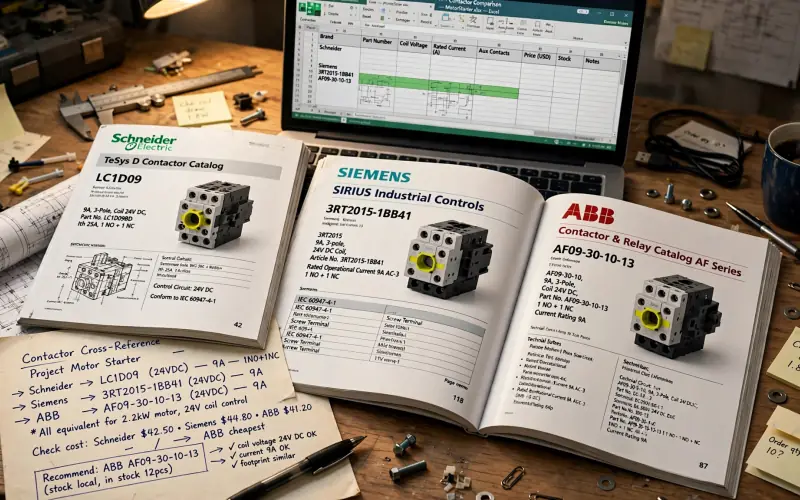
A comparison is only valid if both quotations are for the same device, and in switchgear two part numbers can look identical and describe different products. Makers encode the product in the full part number: the base identifies the series and frame, and the characters after it set the variant. A single character can change:
- the number of poles, three or four;
- the rated current within the frame;
- the breaking capacity version, where one frame is offered at more than one Icu;
- the release type, thermal-magnetic or electronic, fixed or adjustable;
- the coil voltage of a contactor, release or motor operator;
- the terminal type, the mounting or the generation of the range.
When one quotation is noticeably cheaper on what looks like the same device, compare the full part numbers character by character before you compare prices. The cheaper quotation is often for a lower breaking capacity version or an older generation, which may suit your board or may be wrong for its fault level. Our post on the most common switchgear ordering errors covers the suffix mistakes behind most wrong deliveries, and our guide to switchgear brand cross-referencing explains why an equivalent from another make needs the same scrutiny.
Check the suffix before the price. In our view a cheaper quotation for the wrong device is the most expensive mistake on this page.
What a credible delivery commitment looks like
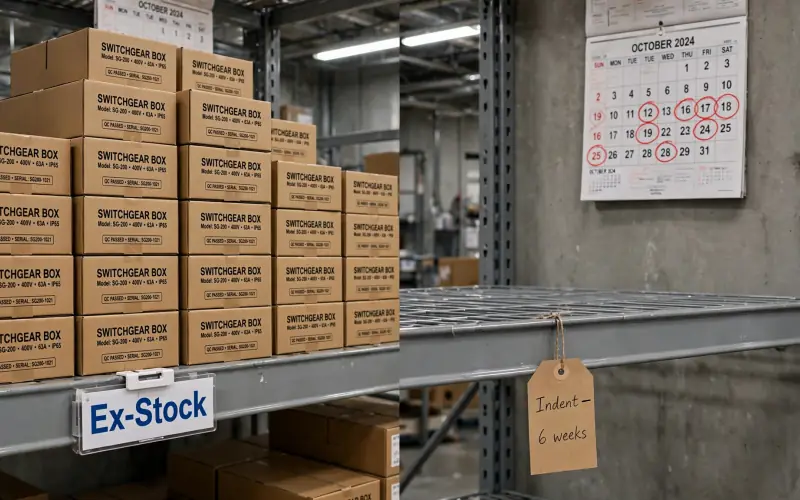
Delivery is the line that most often explains a price gap. A seller holding the device in a godown has paid for that stock and prices it accordingly. A seller quoting against a factory order — an indent — has paid for nothing yet and can offer a deeper discount, with a longer wait attached. Both are honest offers. The problem is a quotation that does not say which one it is.
Ask these questions before you accept any delivery promise:
- Is this exact part number, with this suffix, in your stock today, and at which location?
- Is the date you have given me a dispatch date or a delivery date?
- If the main device is in stock, are its accessories in stock too?
- If the line is on indent, has the factory order been placed, or will it be placed only after my purchase order?
- What happens if the date slips — can I cancel the line without penalty?
A seller who answers all five clearly is giving you a commitment. A seller who answers none is giving you an estimate. Our post on switchgear lead times explains how to plan a project to dispatch dates you can rely on.
We think “ex-stock” should mean on the shelf today, and we tell buyers to treat any quotation that will not say so in writing as indent.
GST, validity and the terms printed under the table
The terms below the item table are part of the price. Read them as carefully as the rates.
- GST. Check that each line shows its HSN code and tax separately, and that the seller's GSTIN is valid. Rates are set by notification and differ by item, so confirm them on the official GST portal rather than from an old quotation or a rate table in a blog post.
- Validity. Most quotations hold for a fixed number of days. When a maker revises its price list inside that window, a seller may honour the old rate only until validity lapses, and an approved quotation left waiting for a purchase order can expire and be re-quoted at the new list.
- Price basis. Check whether the rate is firm until delivery or follows the list in force on the date of dispatch. On indent lines with long lead times, that clause decides who carries a mid-order price revision.
- Warranty. Ask when the warranty starts — on invoice, on dispatch or on commissioning — and whether a claim runs through the seller or directly to the manufacturer.
- Returns. Find out whether an unused, unopened device can be returned, and at whose freight cost, before you order rather than after a wrong part arrives.
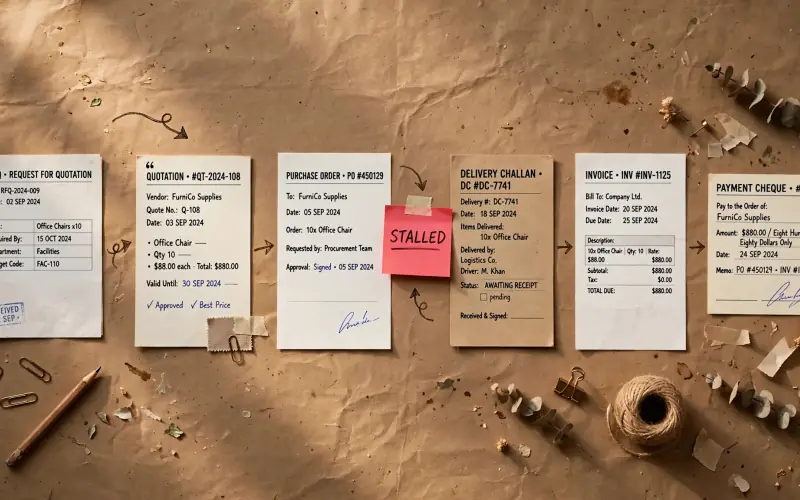
Our guide to the electrical procurement process from RFQ to payment walks through what each of these terms does at the purchase order and invoice stages.
In our view validity and price basis belong on the face of every quotation, not in the small print, because they are the two terms that most often turn an agreed price into an argument.
A buyer's checklist for comparing switchgear quotations
Run these seven checks on every quotation before the comparison sheet goes for approval.
- The same part number on every quotation, character for character, suffix included.
- The list price edition stated, and checked against the maker's current price list.
- Discount and net rate shown for each line, not only as a total.
- Freight, packing, forwarding and insurance stated as included, or estimated in writing.
- GST shown separately for each line, with the HSN code and the seller's GSTIN.
- Payment terms, validity period and price basis written on the quotation.
- A stock position and a dispatch date for every line, accessories included.
A quotation that passes all seven can be compared on landed cost. One that fails any of them goes back to the seller with a question before it goes anywhere near a comparison sheet.
Our position
The discount percentage is theatre. A list price exists so that a large discount can be printed against it, and the only number that means anything is the net landed rate. Sellers do not differ on generosity. They differ on the slab the brand put them on, which follows their volume, and on how much freight and credit risk they absorb for you.
From our side of the table: we quote thinner discounts on what we hold and deeper ones on what we indent against a confirmed order, because stock costs money. A buyer comparing only the discount column picks the indent quote every time and meets the lead time later. That is not dishonesty, it is how the trade is built, and it is why two quotes for one part number are rarely the same offer.
The buyer's mistake has a direction: reading the deepest discount as the best price, and comparing part numbers that differ by a suffix. Our own cost for saying this plainly: if you need one item and do not need it soon, the cheapest quote really is the cheapest, and you should take it rather than pay us for availability you will not use.
Questions buyers ask
What is the difference between list price and net rate in switchgear?
The list price is the manufacturer's published reference price for a part number, the same for every seller. The net rate is what a seller actually charges: the list price less the discount they offer. Freight, packing, tax and the cost of payment terms are then added to the net rate to give the landed cost.
Why do two dealers quote different discounts on the same switchgear?
Each dealer buys from the brand on their own discount slab, which follows their volume and commitments, and some can obtain project pricing for a named job. They also differ in what they absorb — freight, credit and the cost of holding stock — so a deeper discount often comes with fewer of those included.
What is project pricing on switchgear?
For a large order against a named project, a seller can ask the manufacturer for a special discount that applies to that job only. It is approved per project and per quantity, so a rate quoted on project pricing will not be repeated on a later, smaller order — and it is not a fair benchmark for one.
Is a higher discount always a better deal?
No. A higher discount on an indent line, with freight extra and full advance, can cost more than a lower discount on an ex-stock line with freight included and credit terms. Compare landed cost and dispatch date, not the discount column.
How long is a switchgear quotation valid?
Validity is set by the seller and stated on the quotation as a number of days. If the maker revises its price list in that period, an unapproved quotation can lapse and be re-issued at the new list, so approve and order inside validity.
Should a switchgear quotation include freight and GST?
It should state both clearly. Freight should be included or estimated in writing, and GST should be shown separately on each line with its HSN code, so you can compare rates before tax and claim input credit correctly. Our brand price lists show the list prices that quotations start from.