Twenty components appear on almost every Indian building and LT panel project: protection devices such as MCBs, RCCBs, MCCBs and ACBs, motor control gear such as contactors and overload relays, measuring devices such as CTs and meters, and wiring items from terminal blocks to cable. Each can be quoted in one pass only when its key ratings are specified.
The 20 components, and what to specify for each
The list below is grouped by job, not ranked. It covers the items that appear on almost every bill of materials for an Indian building, factory or LT panel, and the ratings a seller needs to quote each one without coming back to you with questions.
It is drawn from what recurs on those bills of materials, not from our RFQ log. The order follows the job each item does, not how often it is bought.
Twenty common electrical components and the ratings to specify in an RFQ
| Component | Typical use | Specify at minimum |
|---|---|---|
| MCB | Final circuit protection | Poles, rated current, tripping curve, breaking capacity |
| RCCB or RCBO | Earth leakage protection | Poles, rated current, sensitivity, type |
| MCCB | Feeder and incomer protection | Frame, rated current, poles, Icu and Ics, release type |
| ACB | Main incomer on large boards | Frame, rated current, Icw, fixed or drawout, release, operation |
| Switch disconnector fuse | Isolation with fuse protection | Rated current, utilisation category, fuse type and rating |
| Surge protective device | Protection against transient overvoltage | Type, Uc, discharge current, Up, poles |
| Contactor | Switching motors and loads | Rating for the duty, coil voltage, auxiliary contacts |
| Thermal overload relay | Motor overload protection | Setting range, trip class, matching contactor |
| Motor protection circuit breaker | Combined motor protection | Setting range, breaking capacity, accessories |
| Push buttons and indicating lamps | Operator control and status | Size, colour, contact type, lamp voltage |
| Selector and cam switches | Manual selection and changeover | Positions, poles, current rating |
| Timers and control relays | Control logic | Function, time range, supply voltage, contacts |
| Current transformer | Inputs for meters and relays | Ratio, burden, accuracy class, window size |
| Multifunction or energy meter | Measuring and recording energy | Parameters, accuracy class, CT input, communication |
| Protection relay | Overcurrent and earth fault tripping | Functions, CT secondary, auxiliary supply |
| Power factor correction capacitor | Reactive power compensation | kVAr, rated voltage, detuned or not |
| Changeover switch or ATS | Switching between mains and generator | Rated current, poles, manual or automatic |
| Distribution board | Housing final circuit devices | Ways, SPN or TPN, IP rating, incomer |
| Terminal blocks | Wiring connections | Conductor size, connection type, rated current |
| LT power and control cable | Power and control wiring | Conductor, cores, size, insulation, armouring |
We would rather a buyer sent one complete line than twenty incomplete ones: a line carrying every rating in the right-hand column can be quoted in one pass.
Protection devices: MCB, RCCB, MCCB, ACB, SDF and SPD
Protection devices are the items most often under-specified, because a part number from an old drawing seems to say everything. It does not say whether the device suits this board's fault level.
MCB
Specify the number of poles — single pole, SP+N, double, triple, TP+N or four pole — the rated current, the tripping curve and the breaking capacity, commonly 6 kA or 10 kA. Curve B suits mainly resistive circuits, curve C general circuits with moderate inrush, and curve D loads with high inrush such as transformers and some motors. MCBs for household and similar installations are made to IS/IEC 60898-1.
RCCB and RCBO
Specify poles, rated current, sensitivity and type. A 30 mA sensitivity is used for the protection of people; 100 mA and 300 mA are used for equipment and fire protection. The type describes the leakage current the device detects: type AC for sinusoidal current, type A where electronic loads produce pulsating DC, and types F or B for drives, inverters and chargers where the equipment maker's instructions call for them. An RCBO combines an RCCB and an MCB in one device.
MCCB
Specify the frame, rated current, poles, the ultimate and service breaking capacities (Icu and Ics) at your system voltage, and the release — thermal-magnetic, fixed or adjustable, or microprocessor-based. Add the mounting, fixed, plug-in or drawout, and every accessory: shunt trip, undervoltage release, auxiliary and alarm contacts, rotary handle, motor operator and terminal spreaders. MCCBs are made to IS/IEC 60947-2.
ACB
Specify the frame and rated current, poles, breaking capacity and short-time withstand (Icw), fixed or drawout, manual or electrical operation, the release and its protection functions, and accessories such as closing and shunt coils, undervoltage release, motor and auxiliary contacts.
Switch disconnector fuse and SPD
For a switch disconnector fuse, give the rated current, the utilisation category, such as AC-22A or AC-23A, and the type and rating of the HRC fuses it will carry. For a surge protective device, give the type — 1, 2 or 3, matching its position in the installation — the maximum continuous operating voltage Uc, the nominal or maximum discharge current, the voltage protection level Up and the number of poles.
Of all the ratings in this section, breaking capacity is the one we would never let a buyer leave out. It has to match the prospective fault current where the device is installed, and only your fault level calculation can tell a seller what that is.
Motor control: contactors, overload relays, MPCBs and pilot devices
Motor control gear is ordered in large numbers and in combinations, which is where transcription errors multiply.
- Contactor. Give the rating for the duty — AC-3 for squirrel-cage motors, AC-1 for resistive loads, and a capacitor duty contactor for capacitor banks — the coil voltage and type in words, and the auxiliary contacts needed. Contactors are made to IS/IEC 60947-4-1.
- Thermal overload relay. Give the setting range that covers the motor's full-load current, the trip class and the contactor it must mount on; overload relays usually fit only their own maker's contactor range.
- Motor protection circuit breaker. Give the setting range, the breaking capacity at your fault level, and accessories such as auxiliary contacts.
- Push buttons and indicating lamps. Give the mounting size, commonly 22 mm, the colour and legend, the contact type — normally open or normally closed — and, for lamps, the supply voltage.
- Selector switches, cam switches, timers and control relays. Give the number of positions and poles, the current rating, the timing function and range, and the coil or supply voltage.
Our post on the most common switchgear ordering errors explains why coil voltage and duty category are the two fields that go wrong most often on contactor orders.
State coil voltage in words, never as a code: the suffix for the same voltage differs from one maker to the next, and a code copied from another brand's catalogue orders the wrong coil.
Measurement and protection: CTs, meters and relays
- Current transformer. Give the ratio, such as 400/5 A or 400/1 A, the burden in VA, the accuracy class — 0.5 or 1 for metering, 5P10 or 5P20 for protection — and the window or busbar size it must fit. Match the secondary current to the meter or relay it feeds.
- Multifunction or energy meter. Give the parameters you need, the accuracy class, the CT secondary input, 1 A or 5 A, the auxiliary supply and any communication port, such as RS-485 Modbus.
- Protection relay. Give the protection functions, for example overcurrent and earth fault, the CT secondary rating, the auxiliary supply voltage and the number of output contacts.
A CT ordered without burden or class is the classic RFQ that cannot be quoted. The seller can guess, but a metering CT used for protection, or the reverse, will not do its job.
In our view a CT line should never reach a seller without its class and burden: those two fields decide whether the device works, and the rest is fit.
Distribution and wiring: capacitors, changeovers, boards, terminals and cable
- Power factor correction capacitor. Give the kVAr rating, the rated voltage and whether the bank is detuned with a series reactor, which the harmonic content of the installation decides. Capacitors are switched by capacitor duty contactors or thyristor switches, not by ordinary contactors.
- Changeover switch or ATS. Give the rated current, the number of poles — four-pole where the neutral must be switched between sources — and whether changeover is manual or automatic.
- Distribution board. Give the number of ways, single or three phase (SPN or TPN), the incomer type and rating, the enclosure's IP rating and whether you need a single or double door.
- Terminal blocks. Give the conductor cross-section, the connection technology — screw, spring or push-in — the rated current, and the accessories: end plates, jumpers and markers, which are rarely interchangeable between makers.
- LT power and control cable. Give the conductor, copper or aluminium, the number of cores, the cross-section, the insulation, PVC or XLPE, armoured or unarmoured, the voltage grade, such as 1.1 kV, and any fire performance requirement, such as FRLS. Add the lugs and glands that go with it.
Several of these products — among them MCBs, RCCBs and PVC-insulated wiring cables — fall under a BIS quality control order and must carry the ISI mark. The list of products covered is amended from time to time, so check it on the BIS website before you specify, and see our guide to verifying genuine switchgear for how to check an ISI licence number on what arrives.
Cable is easy to quote on the wrong basis, because size alone does not describe it: two quotations for “4-core 95 sq mm” can be for different conductors, insulation and armour. In our view every cable line should name all five.
Electrical items buyers often confuse
Several of the twenty come in pairs that look interchangeable on a bill of materials and are not. Stating the job, not just the item name, removes the ambiguity.
Pairs of electrical items that are often confused, and how to tell them apart
| Pair | The difference | What to state in the RFQ |
|---|---|---|
| RCCB and RCBO | An RCCB detects earth leakage only; an RCBO adds overcurrent protection | Which protection the circuit needs, and the curve and breaking capacity for an RCBO |
| MCB and MCCB at one current | The MCCB offers higher breaking capacity and often adjustable settings | The fault level at the board, which decides between them |
| Contactor and MPCB | A contactor switches the load; an MPCB protects the motor | Both lines, and whether they are to be combined as a starter |
| SDF and MCCB | An SDF isolates and protects with replaceable fuses; an MCCB trips and is reset | The protection approach shown on the drawing |
| TP+N and four-pole MCB | A TP+N device switches the neutral without protecting it; a four-pole device protects the fourth pole too | Whether the neutral needs protection as well as switching |
| Metering and protection CT | Metering CTs are accurate at normal load; protection CTs stay accurate up to fault currents | The class: 0.5 or 1 for a meter, 5P10 or 5P20 for a relay |
| Armoured and unarmoured cable | Armour gives mechanical protection for buried and exposed runs | The installation method, so the right construction is quoted |
When an RFQ names the item and the job together — “RCBO, 32 A, curve C, 10 kA, 30 mA type A, for socket circuits” — the seller has nothing to guess, and you get back a quotation you can compare.
What makes an electrical RFQ complete
Beyond the ratings of each item, five details decide whether an RFQ can be quoted in one pass or turns into a round of questions:
- Quantity for every line, including spares.
- Delivery location with a PIN code, so freight and tax can be calculated.
- Required date, and whether part deliveries are acceptable.
- Make preference — a named make, an approved list, or open to equivalents.
- Fault level and system voltage for every protection device, so breaking capacity can be checked.
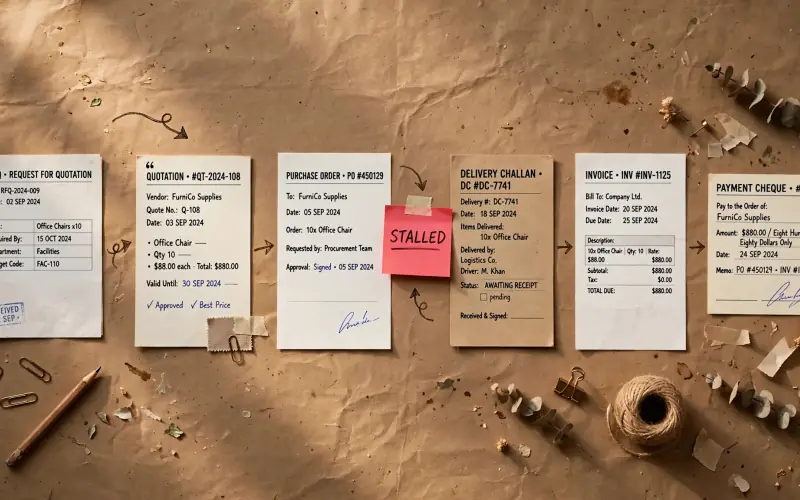
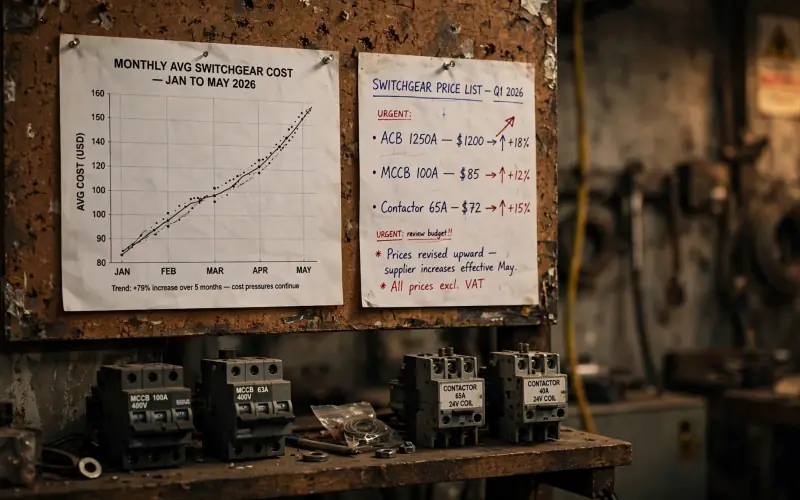
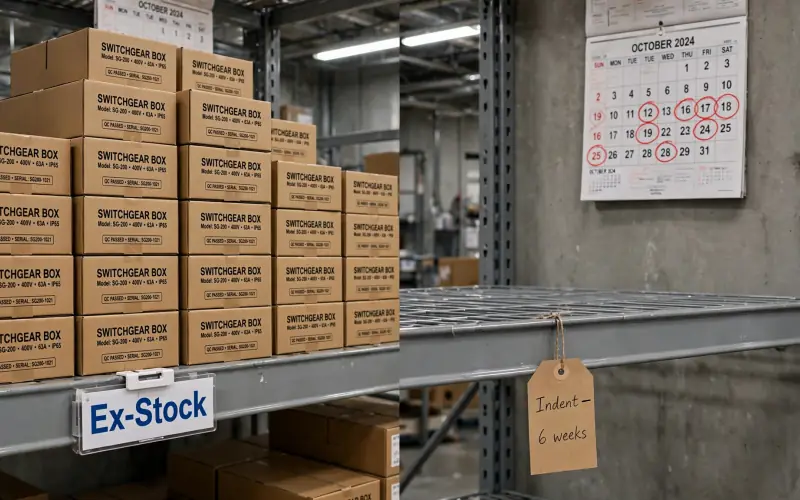
Our guide to the electrical procurement process explains how a complete RFQ shortens every later stage, and our post on reading switchgear quotations covers what to check when the quotes come back. Where list prices are moving, see switchgear price increases, and for which of these items take longest to arrive, switchgear lead times.
Most RFQs that stall do not stall on price. In our view they stall because one of these five details is missing and the seller's question sits unanswered.
Our position
Which items are requested most is the dull half of RFQ data. What is worth reading is the gap between what gets asked for most and what actually converts, because the items that stall mostly stall for two reasons and neither is price. Either the request arrives without enough specification to quote against — a breaker rating with no fault level, a CT with no burden or class, a contactor with no coil voltage — or it is a commodity line where the buyer is collecting a third quote to beat a rate already agreed. The first is fixed by asking one question. The second is not worth chasing.
Some of the worst conversions in our own RFQ log are ours to own. A line requested often and converted badly is usually our stocking decision rather than buyer behaviour: we quoted it slowly, or quoted indent against a seller who had it on the shelf. Read honestly, poor conversion on a popular line points to our own gaps.
Two mistakes, in opposite directions. Buyers send under-specified requests and read the silence as seller indifference. Sellers read a high request count as demand and stock the top of the list without looking at the conversion column beside it.
Questions buyers ask
What are the most commonly used electrical components in a panel?
Most LT panels carry an incomer, an ACB or MCCB, outgoing MCCBs or MCBs, contactors and overload relays for motor feeders, CTs with meters and protection relays, push buttons and indicating lamps, terminal blocks, and the power and control cable that connects them.
What is the difference between an MCB, an MCCB and an ACB?
They differ in current range and breaking capacity. MCBs protect final circuits at lower currents; MCCBs protect feeders and incomers at higher currents, many with adjustable releases; and ACBs serve as main incomers on large boards, with the highest ratings and a short-time withstand rating.
What details should an electrical RFQ include?
For every line: the full specification or part number, the quantity and the key ratings. For the whole RFQ: the delivery location with PIN code, the required date, the make preference and the fault level at each protection device.
Which electrical products need the ISI mark in India?
Products covered by a BIS quality control order must carry the ISI mark, and the list includes MCBs, RCCBs and PVC-insulated wiring cables among others. It is amended over time, so confirm the current scope on the BIS website.
Which electrical components does a building project need?
A typical building needs a main incomer and distribution boards, MCBs and RCCBs for final circuits, a surge protective device, a changeover or ATS where there is a generator, meters, power factor correction on larger connections, and power cable, wiring cable, lugs and glands. The exact list follows the single-line diagram.
How do I specify an MCB correctly?
Give the number of poles, the rated current, the tripping curve — B, C or D — and the breaking capacity, which must be at least the prospective fault current at the board. Add the make preference if your specification names one.