A switchgear cross-reference matches devices from different makers on published ratings: poles, rated current, breaking capacity, release, coil voltage and mounting. It gives you the closest functional equivalent, not a drop-in substitute. Coordination tables, accessories, mounting and approvals do not transfer between brands, so treat every equivalent as a shortlist entry to check.
How to use a cross-reference, and how not to
A cross-reference is safe for two jobs. The first is pricing a board before the brand decision is made, so that quotations from different makes can be compared on like-for-like ratings. The second is finding a standby for a device that is obsolete or no longer available from its original maker.
It stops being safe the moment anything above or below the device depends on the choice — a discrimination study, a tested coordination, an approved makes list or a type-tested panel design. In those cases an equivalent is a proposal to be checked and approved, not a substitution to be made on site.
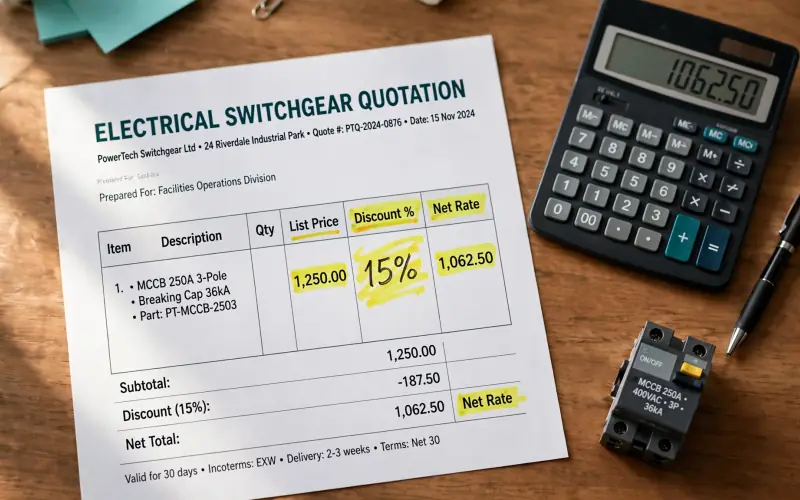
If you are pricing a board across makes, send sellers the ratings rather than one maker's part number. A seller asked to quote “equivalent to” a part number may pick a lower breaking capacity or a simpler release to win on price, and the quotation will not say so.
The tables in this guide therefore list what to match and where to find it, not part numbers. A part number equivalence is only useful once it has been verified against both makers' current catalogues, and an unverified row is a liability, not a reference.
How makers encode a device in its part number
Before you can match two devices, you have to read what each part number says. Every maker builds its part numbers differently, but most encode the same things in the same rough order:
- The range or series, which identifies the product family and its generation.
- The frame, which sets the physical size, the maximum current and the accessories that fit.
- The rating, the rated current, or for a contactor the size it is sold by.
- The breaking capacity version, where one frame is offered at more than one Icu.
- The poles, three or four.
- The release or coil, thermal-magnetic or electronic for a breaker, the coil voltage for a contactor.
- The connection and mounting, such as front or rear terminals, fixed or plug-in.
The order, the codes and even which items appear in the number differ between makers. That is why a cross-reference built by lining up characters from two catalogues goes wrong: the characters mean different things. Decode each part number against its own maker's current catalogue, then compare the decoded ratings.
What to match on an MCCB
Take every row below from the current catalogue of each maker, at your system voltage.
MCCB parameters to match across brands
| Parameter | Where to find it | Why it matters |
|---|---|---|
| Poles | Part number and catalogue selection table | Three- and four-pole versions are different devices |
| Rated current | Selection table | Must match, with the same adjustment range if the release is adjustable |
| Frame size | Selection table and dimensions | Sets the physical size, the accessories and the panel cut-out |
| Icu and Ics at 415 V | Technical data | The equivalent must break the same prospective fault current |
| Release type and settings | Release section of the catalogue | Thermal-magnetic and electronic releases protect differently |
| Mounting | Ordering information | Fixed, plug-in and drawout versions are not interchangeable |
| Terminals and dimensions | Dimension drawings | Decide whether the device fits the existing busbars and space |
| Accessories | Accessory section | Shunt trips, contacts and handles rarely cross brands |
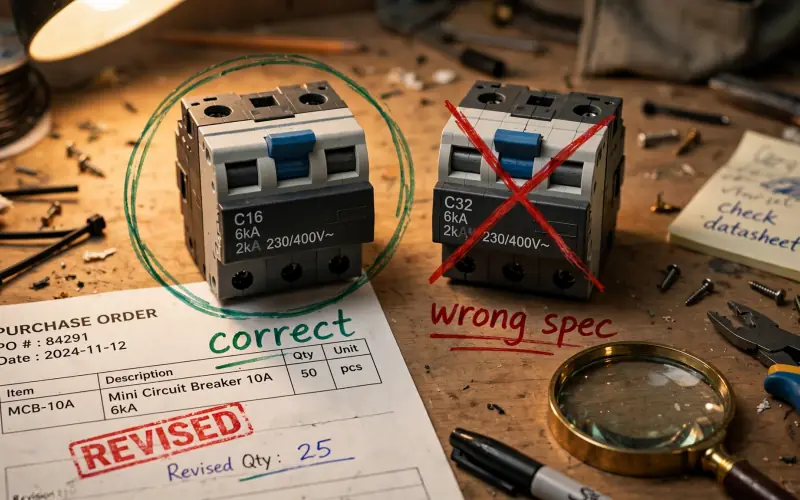
Matching the first two rows and stopping there is the commonest cross-referencing error. Two breakers with the same poles and current can differ in breaking capacity, release behaviour and size by enough to fail in the panel they were meant for.
In our view a cross-reference row without a differences column is a claim, not a reference.
A worked method: cross-referencing one MCCB
Suppose the specified device is described by its ratings as a 250 A, four-pole, fixed, front-connected MCCB with an adjustable thermal-magnetic release, an Icu of 36 kA at 415 V, a shunt trip for 230 V AC and two auxiliary contacts. To find its closest equivalent in another maker's range:
- Find the frames in the second maker's catalogue that cover 250 A in a four-pole version.
- Within those, choose the breaking capacity version whose Icu at 415 V is at least 36 kA, and note its Ics.
- Choose a release whose adjustment range covers the current the feeder is set to, not just its maximum.
- Confirm that a 230 V AC shunt trip and two auxiliary contacts exist for that frame, and whether they are field-fittable.
- Compare dimensions, terminal arrangement and mounting with the space and busbars in the panel.
- Check selectivity and any backup protection against the devices above and below it, using the second maker's tables or a fresh study.
- Write down every difference you found, however small, beside the proposed part number.
Only the last step produces something you can send for approval. A part number without the differences beside it hides the work, and with it the questions an approver needs to ask.
Replacing an obsolete device
When the original series has been discontinued, look to its own maker first. Manufacturers usually publish a successor for each discontinued range, sometimes with a migration guide, and on some ranges retrofit kits or adaptor plates that let a new device take the old one's place in an existing panel. A successor from the same maker still needs the checks above — a new generation can change dimensions, accessories and characteristics — but its maker can usually tell you what changed.
Cross to another maker only when the original maker has no suitable successor, or cannot supply it in time. In either case, record the change on the drawings and the spares list.
What to match on a contactor
- Rating for the duty. The AC-3 rating at 415 V for motors and the AC-1 rating for resistive loads, both taken from the catalogue rather than from the frame name.
- Coil voltage and type. AC or DC, voltage and frequency. Each maker uses its own suffix codes for coil voltages, so the same code can mean different coils in different catalogues.
- Auxiliary contacts. The built-in contacts and the add-on blocks available, which are specific to each range.
- Overload relay fit. Overload relays usually mount only on their own maker's contactors, so changing the contactor often changes the relay too.
- Interlocks and accessories. Mechanical interlocks for reversing pairs, surge suppressors and timer blocks are range-specific.
- Dimensions. Width and mounting must suit the space on the existing plate or rail.
Coil voltage is where contactor swaps fail most often, because the error stays invisible until the control circuit is energised. Our post on the most common switchgear ordering errors covers this and the other suffix mistakes.
What to match on a terminal block
- Conductor range. The smallest and largest cross-section the terminal accepts, and whether ferrules are needed.
- Connection technology. Screw, spring or push-in. Mixing technologies on one rail changes the wiring method and the tools needed.
- Rated current and voltage. From the maker's data under IEC 60947-7-1, or IEC 60947-7-2 for protective earth terminals.
- Width and rail. The pitch sets how many terminals fit on an existing rail.
- Accessories. End plates, jumpers, test plugs and markers are designed for one maker's profile and are rarely interchangeable.
Marker systems are the detail that surprises buyers: a terminal block that matches on every rating can still need a different marker system, printer template and jumper range from the one the panel builder already uses.
Cross-referencing MCBs, RCCBs, CTs and meters
The same discipline applies to the smaller devices, with a few points of their own:
- MCBs. Match poles, rated current, tripping curve and breaking capacity, and check that the replacement fits the existing distribution board's busbar and cover. Busbars and accessories are often specific to a maker's range.
- RCCBs and RCBOs. Match poles, rated current, sensitivity and type — AC, A, F or B — as well as the curve and breaking capacity of an RCBO.
- Current transformers. Match ratio, burden, accuracy class and the window or busbar size. A CT from another maker can be electrically equivalent and still not fit the space or the busbar.
- Meters and relays. Match the measured parameters, accuracy class, CT input, auxiliary supply, communication protocol and register map, and the panel cut-out. A meter that reports the same values over a different register map can break a building management system's readings.
For each of these, the ratings to state are the ones in our post on the 20 most used electrical components.
Why coordination and selectivity do not transfer between brands
Some properties belong to a combination of devices, not to any one of them, and each manufacturer tests and publishes them for its own products only.
- Type 2 coordination. Under IS/IEC 60947-4-1, a motor starter — short-circuit protective device, contactor and overload relay — is tested as a combination. Type 2 means the starter remains fit for further use after a short circuit, with at most light contact welding that is easily separated. The maker's coordination table lists the combinations that achieved it, and replacing one device with another brand's takes the starter outside the tested set.
- Selectivity. Discrimination between an upstream and a downstream breaker is published as tables for each maker's own device pairs. A scheme that is selective on paper with one brand may not be with a mixed pair.
- Backup protection. Cascading, where an upstream breaker helps a downstream one interrupt a fault beyond its own rating, is valid only for the tested combinations in the maker's tables.
- Type-tested assemblies. A panel verified to IS/IEC 61439 was verified with specific devices. Substituting a device can require the affected verifications, such as temperature rise, to be reassessed.
When a cross-referenced device enters any of these schemes, the study has to be redone with the new device, not assumed.
This is the reason we call a cross-reference a shortlist: the device may be equivalent, and the system it sits in still has to be proved again.
When a substitution will be rejected
Even a perfect technical equivalent can be refused. Expect a substitution to need formal acceptance when:
- the tender or contract names the make, or lists approved makes without an “or equivalent” clause;
- a consultant has approved a specific make on the drawings;
- an OEM or the end client has standardised on one make for spares and maintenance;
- the device sits in a type-tested assembly or a published coordination scheme;
- the existing panel uses one make's accessories, busbar adaptors or mounting.
In each case the equivalent is a deviation. Raising it after the panel is built, at inspection, is the most expensive time to have the argument.
In our view the cheapest approval is the one requested before the order, with the comparison sheet attached, and the most expensive is the one requested in front of an inspector.
How to get an equivalent make approved
- Prepare a comparison sheet listing every parameter from the tables above for the specified device and the proposed one, with the differences stated.
- Attach the evidence: catalogue pages, type test certificates and, where relevant, the proposed make's coordination and selectivity tables.
- Explain the reason — availability, lead time or obsolescence — because approvers are more willing when a substitution solves a problem.
- Get written acceptance from the consultant or client before ordering, not after delivery.
- Update the drawings and spares list so that the next person maintaining the panel knows which make is installed.
When you are pricing a board across makes, our guide to reading switchgear quotations explains how to compare what comes back, and our guide to the electrical procurement process shows where deviation approval fits in the cycle. Current list prices for the makes we track, including Lauritz Knudsen, ABB and C&S Electric, are on our price list pages.
Our advice is the same every time: written approval first, order second.
Our position
A cross-reference is a shortlist, not a substitution. Matched on published ratings, it is safe for two jobs: pricing a board before the brand decision is made, and buying a standby for a device that is obsolete or no longer available. It stops being safe the moment anything above or below the device depends on the choice.
The failure we see is substitution on frame and rating alone. Coordination tables do not cross manufacturers, so a discrimination scheme that is correct on paper becomes untrue in the panel. Coil voltage suffix conventions differ by brand, so an identical-looking contactor arrives with a coil the control circuit will not drive. Accessories, mounting, terminal arrangement and marker systems do not transfer either. And where a specification names the brand, an equivalent is a deviation needing written acceptance before the panel is built, not a case to argue at inspection.
We have had a row wrong in our own quoting — an equivalence taken from a rating table without checking that the accessory range matched — and the buyer found out at wiring, not at order. That is why, in our view, every cross-reference row needs a differences column instead of a clean one-to-one claim.
Questions buyers ask
Can I replace an ABB MCCB with a Lauritz Knudsen MCCB?
Often, at the device level, if poles, rated current, breaking capacity at 415 V, release type, mounting and dimensions all match. But accessories, coordination and selectivity tables do not transfer, and a specification that names the make needs written approval for the change.
Are contactor coil voltage codes the same across brands?
No. Each maker uses its own suffix codes for coil voltages, so a code copied from one brand's catalogue can order the wrong coil from another. State the coil voltage in words and check the code in the maker's current catalogue.
What is Type 2 coordination?
A tested combination of short-circuit protective device, contactor and overload relay that remains fit for further use after a short circuit, with at most light, easily separated contact welding. It is defined in IS/IEC 60947-4-1 and published by each maker for its own combinations.
Do I need a new coordination study after changing brands?
For any device that sits in a coordination, selectivity or backup protection scheme, yes. Those properties are tested for specific combinations of one maker's devices, so the scheme has to be checked again with the new device rather than assumed to hold.
Does “or equivalent” in a tender allow any brand?
It allows a proposal, not an automatic substitution. The bidder usually has to show that the equivalent meets every specified parameter, and the consultant or client decides whether to accept it.
Where can I find an MCCB cross-reference chart?
Some makers publish competitor cross-reference guides for their own ranges, and they are a useful starting point. Treat any chart as a shortlist: verify each row against both makers' current catalogues before you order.