The cycle runs RFQ, quotation, purchase order, proforma invoice, dispatch, tax invoice, payment. Most of the elapsed time sits in two places: waiting for quotations to come back, and waiting for approval between quotation and PO. Shorten those two, with a complete RFQ and approval inside quotation validity, and the whole cycle shortens.
The seven stages of electrical procurement
Every purchase of electrical goods in India, from a box of MCBs to a set of panel switchgear, moves through the same seven stages. The names vary between organisations; the sequence does not.
The electrical procurement cycle and the document at each stage
| Stage | Document | Issued by |
|---|---|---|
| 1. RFQ | Request for quotation, with specifications and quantities | Buyer |
| 2. Quotation | Quotation with rates, terms and validity | Seller |
| 3. Purchase order | Purchase order referencing the accepted quotation | Buyer |
| 4. Proforma invoice | Proforma invoice for any advance payment | Seller |
| 5. Dispatch | E-way bill where required, packing list, transporter's consignment note | Seller and transporter |
| 6. Tax invoice | GST tax invoice, issued as an e-invoice where the seller must | Seller |
| 7. Payment | Payment against invoice, after goods receipt and reconciliation | Buyer |
In practice the tax invoice usually travels with the goods, so stages five and six happen together. They are separated here because they answer different questions: whether the goods arrived, and whether the paperwork lets you pay and claim tax credit.
Most of the elapsed time sits before the purchase order, not in dispatch, and in our view that is where buyers should look first when a cycle runs long.
Who owns each stage of the buying process
In a business purchase, the seven stages pass through several hands, and most delays happen at the handovers rather than inside any one team:
Roles in a B2B electrical purchase, and where the handover fails
| Role | Owns | Where the handover fails |
|---|---|---|
| Project or site engineer | Specification, quantities and the required date | A specification copied from an old drawing, or spares left out |
| Purchase team | RFQ, comparison and the purchase order | Questions from sellers waiting on the engineer |
| Approver | Commercial approval of the comparison | Approval arriving after the quotation's validity |
| Finance | Advances and payment | An advance released days after the proforma arrives |
| Stores or site team | Receipt and inspection | A delivery note signed without checking the goods |
| Accounts | Invoice matching and tax credit | Invoices that do not match the purchase order or the GST records |
Naming one owner for each handover, and a time within which it should happen, does more for cycle time than any change in suppliers.
Stage 1: the RFQ
The RFQ sets the pace of everything after it. A request that a seller can quote in one pass gets quotations back quickly; one missing a key detail turns into rounds of questions, which the buyer then records as supplier slowness.
A usable electrical RFQ contains:
- the full part number, or a full specification, for every line;
- the quantity for every line, including spares;
- the delivery location, with PIN code;
- the required date, and whether part deliveries are acceptable;
- the make preference — a named make, an approved list, or open to equivalents;
- the fault level and system voltage for every protection device;
- the documents you need with the goods, such as test certificates.
Send the same RFQ, with the same specification, to every seller you ask — authorised distributors, dealers or a marketplace — so that the quotations come back on one basis and can be compared line for line. A seller who quotes something different from what was asked has made the comparison harder, not cheaper.
Our post on the 20 most used electrical components lists the ratings to specify for each common item, and our post on switchgear ordering errors covers the specification mistakes that most often send an RFQ back.
In our view one complete RFQ to three sellers beats three incomplete ones to ten: the quotations come back faster and they can be compared.
Stage 2: comparing quotations
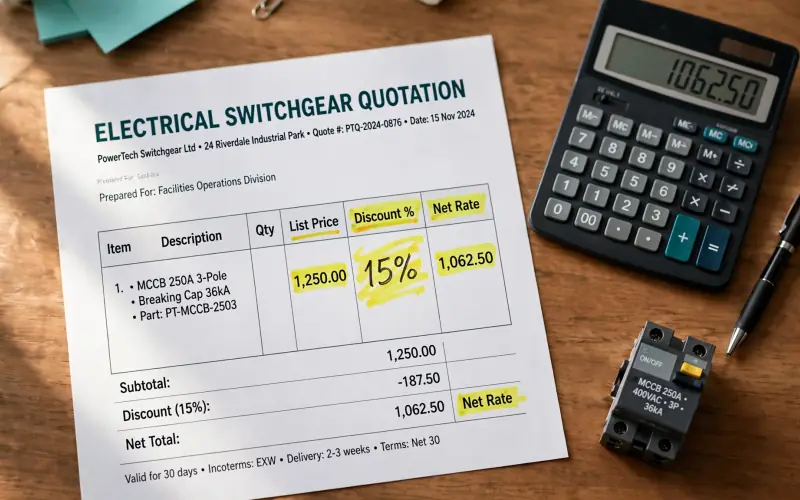
When the quotations come back, compare them on landed cost rather than discount: the net rate plus freight, packing and insurance, adjusted for payment terms, with tax checked separately. Confirm that every quotation is for the same part number, suffix included, and that each states its stock position and a dispatch date. Our guide to reading a switchgear quotation works through a two-seller comparison.
Watch the validity date. In a rising market, a maker's price list revision can fall inside the time your approval takes, and an approved quotation that lapses before the purchase order is issued may be re-quoted at the new list. The comparison then has to be redone at new prices. Our post on switchgear price increases explains how revisions reach quotations.
In our view a comparison that takes longer than the quotations' validity has cost more than any line-by-line saving it found.
Stage 3: approval and the purchase order
Approval is the longest stage in many organisations, and the one buyers least often measure. Quotations wait in inboxes for a signature while their validity runs out. Shortening approval — delegated limits for routine purchases, a pre-approved makes list, standard purchase order templates — usually saves more time than chasing sellers.
A complete purchase order prevents most later disputes. It should state:
- the buyer's and seller's names, addresses and GSTINs;
- the quotation it accepts, by number and date;
- each line's full part number, description, quantity and net rate;
- the freight terms — delivered to site, or ex-works with the buyer arranging transport — and who unloads;
- the tax treatment, payment terms and price basis for indent lines;
- the delivery address, the required date and whether part deliveries are allowed;
- inspection, acceptance and warranty terms, and any penalty for late delivery.
Vague freight and tax lines are the commonest source of argument at invoice stage. If the quotation said “freight extra”, the purchase order should say how much, or how it will be calculated.
Stage 4: proforma invoice and payment terms
Where the seller asks for an advance, they issue a proforma invoice: a statement of what will be supplied and the amount due, used to request payment. It is not a tax invoice, and you cannot claim input tax credit on it.
Each common payment term changes the lead time in its own way:
Payment terms in electrical procurement, and what each does to delivery
| Term | How it works | Effect on lead time |
|---|---|---|
| Full advance | Payment against the proforma before dispatch, or before the factory order | The clock starts only when the advance lands |
| Part advance | A share in advance, the balance before dispatch or on delivery | Indent lines are usually ordered once the advance arrives |
| Against delivery | Payment when the goods arrive | When stock is short, orders paid in advance may be filled first |
| Credit | Payment a fixed number of days after the invoice | Depends on the buyer's credit standing; its cost is priced into the rate |
Credit is not free. It is priced into the rate and, when stock is short, into the order in which a seller fills orders. An advance often buys a faster dispatch than any amount of negotiation does.
Stage 5: dispatch and delivery
Goods should travel with their documents. For electrical consignments in India, expect:
- The tax invoice, or a delivery challan for movements that are not sales.
- An e-way bill, generated on the GST e-way bill system for consignments above the value threshold set in the rules.
- The transporter's consignment note or lorry receipt, naming the carrier and the number of packages.
- A packing list that matches the purchase order lines.
- Test certificates and warranty cards where the maker issues them, and any inspection report agreed in the purchase order.
Inspect on receipt, before you sign the delivery note without remarks: count the packages, check for transit damage, and match part numbers and quantities against the purchase order. Our guide to verifying genuine switchgear sets out the authenticity checks to run on what arrives, and our post on switchgear lead times covers how to plan dispatch dates you can rely on.
In our view the delivery note is the cheapest place to record a problem: a remark written at the door is evidence, and a complaint made a week later is an argument.
Stage 6: the tax invoice and GST
A GST tax invoice for goods must carry, among other details:
- the supplier's name, address and GSTIN;
- a unique serial number and the date of issue;
- the recipient's name, address and GSTIN;
- the HSN code, description, quantity and unit of each item;
- the taxable value, the tax rate and the amount of each tax charged;
- the place of supply, which decides whether CGST and SGST or IGST applies;
- the signature or digital signature of the supplier.
Sellers above the turnover limit notified for e-invoicing must also register each invoice on the government's invoice registration portal, which adds an Invoice Reference Number and a QR code to it. Input tax credit generally depends on the invoice appearing in your GST records after the seller files their return, so reconcile your purchase invoices against those records every month.
Tax rates, thresholds and rules change by notification. Check them on the official GST portal, gst.gov.in, and confirm the treatment of your purchases with your own tax adviser rather than a rate table in a blog post or an old invoice.
Stage 7: payment and reconciliation
Before payment, match three documents line by line: the purchase order, the goods receipt and the tax invoice. Differences fall into a few familiar groups:
- Short or excess supply, settled by a debit or credit note rather than by editing the invoice.
- Rate differences, usually a question of price basis or validity left open at stage three.
- Freight and other charges that were never agreed on the purchase order.
- Damaged or wrong items, recorded at receipt and returned or replaced under the order terms.
Disputes at this stage almost always trace back to something left vague earlier: freight, tax, price basis or the specification itself.
In our view every dispute in this list is cheaper to settle on the quotation than on the invoice.
Where electrical procurement deals stall
Deals rarely die at dispatch. They stall earlier, and for a small number of reasons:
- At the RFQ, when a request without quantity, location, fault level or make preference cannot be quoted in one pass.
- At approval, when a compared and agreed quotation waits for a signature until its validity lapses.
- At payment terms, when the seller needs an advance the buyer's process cannot release quickly, or the buyer needs credit the seller will not extend.
None of these is a price problem, and none is solved by asking for a deeper discount.
How to shorten the procurement cycle
The actions differ by side of the table, but they meet in the same place: a complete request answered by a complete quotation.
For buyers
- Send complete RFQs, with every line specified and the delivery PIN code stated.
- Approve inside quotation validity, and set delegated limits for routine purchases.
- Keep a pre-approved makes list, so equivalents do not wait for a decision.
- Release advances promptly on indent lines that are on the critical path.
- Order accessories on the same purchase order as their devices.
For sellers
- Quote every line, or say clearly which lines you cannot.
- State the stock position and a dispatch date for every line.
- Show freight, packing and tax explicitly — never “extra” without an estimate.
- Ask one complete set of questions, once, rather than one at a time.
- Answer a complete RFQ before chasing an incomplete one.
For items that are unusual, urgent or outside your normal channel, an RFQ on VendorStocks reaches verified sellers across India in one request; for the list you buy every month, a rate contract with a local distributor is usually faster.
Our position
Seven stages, and the two that consume the time are the two nobody tries to fix. Buyers spend their effort comparing quotations line by line, then let the approved quotation sit waiting for a signature until its validity lapses, and the whole comparison has to be redone at new prices.
The delay is created at the RFQ. An enquiry without quantity, delivery location, fault level or a clear make preference cannot be quoted in one pass, so it turns into several rounds of questions, and the buyer records that as supplier slowness. Payment terms are the other one. Credit is not free — it is priced into the rate and into the lead time — and an advance often buys dispatch faster than a negotiation does.
Our side of the table stalls too. We have sent quotations with vague freight and tax lines that became an argument at invoice stage, and we have let a complete enquiry wait while we chased an incomplete one. And if you buy the same list every month, a rate contract with a local distributor will beat a marketplace on cycle time. Use us where the item is unusual, urgent, or outside your normal channel.
Questions buyers ask
What is the difference between a proforma invoice and a tax invoice?
A proforma invoice is a statement issued before supply, used to request an advance; it creates no tax liability and supports no input tax credit. The tax invoice is issued for the actual supply under GST, and it is the document you claim credit on.
What is the difference between a quotation and a purchase order?
The quotation is the seller's offer, with rates, terms and validity. The purchase order is the buyer's acceptance of that offer; once the seller confirms it, the two together form the contract.
Is an e-way bill required for electrical goods?
For the movement of goods above the value threshold set under the GST e-way bill rules, yes, whatever the product. Check the current threshold and exemptions on the official e-way bill portal.
What documents should come with a switchgear delivery?
The tax invoice, an e-way bill where required, the transporter's consignment note, a packing list, and the maker's test certificates and warranty cards where they are issued.
What is a three-way match in procurement?
Checking the purchase order, the goods receipt and the supplier's invoice against each other, line by line, before payment. It catches short supply, wrong items and charges that were never agreed, while they can still be settled with a debit or credit note.
Should I pay an advance to a new electrical supplier?
Only after checking that the supplier is a traceable business: a valid GSTIN in its own name, an address you can verify and, for branded goods, evidence of an authorised source. Pay against a proforma invoice, never in cash, and keep the advance proportionate to the order.
How long does the electrical procurement cycle take?
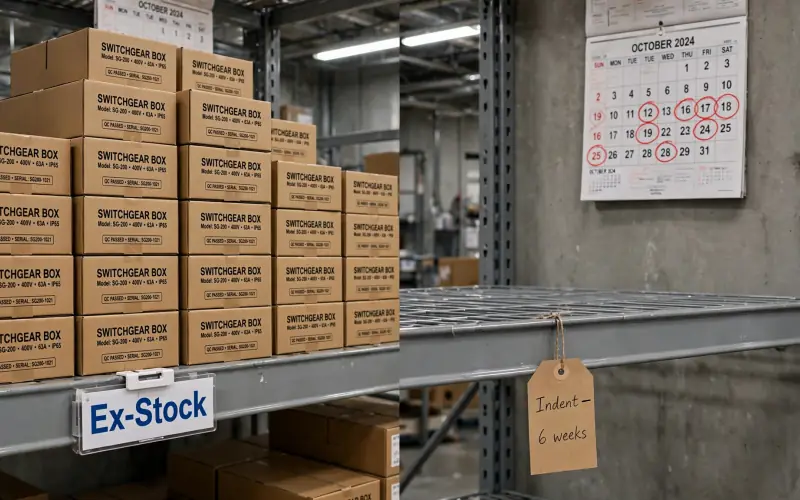
It depends far more on the RFQ and approval stages than on dispatch. A complete RFQ for ex-stock items, approved inside validity, can move from request to delivery quickly; an incomplete RFQ for indent items, waiting on approval, can take many weeks.