A switchgear lead time is the time from a confirmed order to dispatch, and it depends more on how a line is supplied than on its brand. Popular ratings held ex-stock usually dispatch in days; variants, high frames and ACBs made to indent can take weeks. Plan critical lines to the slow tail, not the typical order.
What a switchgear lead time actually measures
A lead time is only a number once you know where the clock starts and stops. Much of the friction between buyers and sellers comes from the two sides measuring different intervals and calling both of them the lead time.
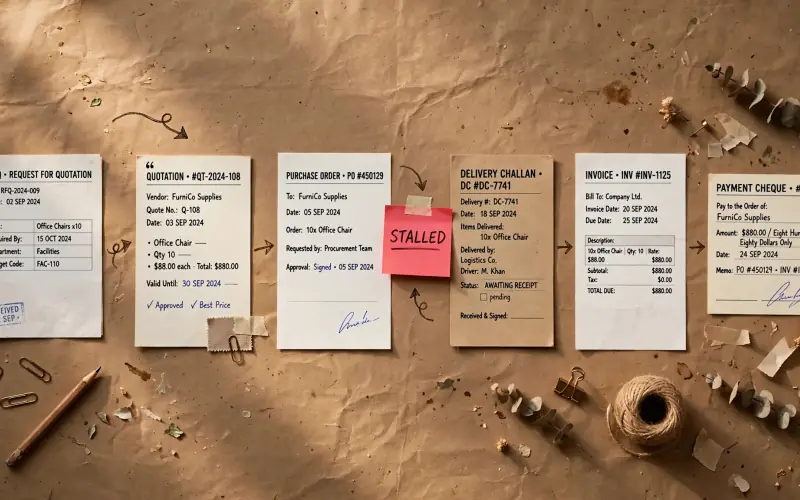
The intervals inside a switchgear order, and who controls each
| Interval | Starts | Ends | Controlled by |
|---|---|---|---|
| Quotation time | RFQ received | Quotation sent | Seller, and how complete the RFQ was |
| Approval time | Quotation sent | Purchase order issued | Buyer |
| Order confirmation | Purchase order issued | Order confirmed, advance received if due | Both |
| Lead time to dispatch | Order confirmed | Goods leave the seller's godown | Seller and manufacturer |
| Transit | Dispatch | Delivery at site | Transporter |
| Receipt and inspection | Delivery | Goods accepted | Buyer |
When a seller quotes “two weeks”, they usually mean confirmed order to dispatch. When a project manager hears “two weeks”, they usually mean purchase order to material on site — which also includes confirmation, any advance payment and transit. The gap between those two readings is where many delivery disputes start.
We measure lead time from confirmed order to dispatch, because that is the part a seller controls, and in our view every delivery promise should say which interval it means.
Ex-stock, regional stock and indent
Every line on a switchgear order reaches you by one of three routes, and the route sets the lead time far more than the brand does.
The route is not always visible on a quotation. Two sellers can quote the same part number with the same dispatch promise, one from a shelf and one from a factory order they have not yet placed. The only way to know is to ask, and to ask for the answer in writing.
Ex-stock
The device is on the seller's shelf. Dispatch depends only on order processing and packing, so it is normally a matter of days. Popular MCB, RCCB and MCCB ratings, standard contactors and common cable sizes are usually available this way from at least some sellers.
Regional or distributor stock
The seller does not hold the part but can draw it from a distributor or the maker's regional warehouse. Add the transfer time, and the risk that the stock is sold to someone else before your order reaches it.
Indent
The line is ordered from the factory against your purchase order, and the lead time follows the maker's production schedule. Air circuit breakers, high-frame and four-pole MCCBs, motor operators, special releases, unusual coil voltages and long-tail variants commonly arrive this way, and their lead times are counted in weeks.
A seller quoting indent with a deeper discount is not doing anything wrong. In our view the only wrong quotation is one that does not say which route the line will take.
Why category and variant matter more than brand
Buyers often ask which brand delivers fastest. The honest answer is that every major brand is fast on its popular ratings and slow on its variants. Within a single brand, a three-pole MCCB in a common rating can be on every distributor's shelf while the four-pole version of the same frame, or the same breaker with a motor operator, is made to order.
Three factors explain most of the difference between a line that ships this week and one that ships next month:
- Depth of channel stock. Distributors stock what sells. Ratings and configurations that move every week are held deep; variants that move a few times a year are held thin or not at all.
- Configuration at the factory. Air circuit breakers and large MCCBs are often built to a configuration — release, accessories, fixed or drawout — so even a well-stocked brand assembles many of them to order.
- The slowest accessory. A line ships complete only when its last part is available. A breaker on the shelf with its shunt trip on indent is an indent line.
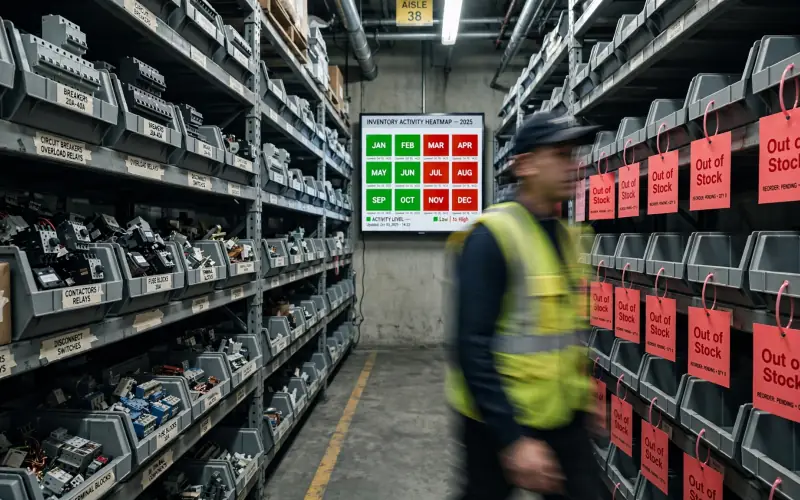
That is why lead times are worth tracking by category and brand together, rather than ranking brands on a single number. Our post on stock-out patterns shows how the same effect plays out in availability.
Switchgear lead times by category: what to expect
The table below describes how each category is usually supplied and what tends to push a line from the shelf onto indent. It is a guide to which questions to ask, not a promise of dates.
How common switchgear categories are usually supplied
| Category | Usual supply route | What tends to lengthen it |
|---|---|---|
| MCBs, RCCBs and distribution boards | Popular ratings usually stocked | Uncommon curves, four-pole versions, particular RCCB types |
| MCCBs | Common three-pole ratings stocked; high frames often indent | Four poles, electronic releases, motor operators, rotary handles |
| ACBs | Mostly configured to order | Drawout versions, communication, special releases, accessories |
| Contactors and overload relays | Common ratings with 230 V AC coils stocked | Large frames, DC coils, uncommon voltages, reversing kits |
| Current transformers | Common ratios stocked by some sellers | Particular ratios, classes, burdens and window sizes |
| Meters and protection relays | Standard models stocked | Communication options and auxiliary supply variants |
| LT cable | Common sizes stocked by distributors | Large sizes, special armouring or fire performance, long drum lengths |
| APFC and LT panels | Built to order | Drawing approval, component lead times and testing |
Read the right-hand column as a checklist. If a line on your order matches anything in it, ask about stock before you plan, because that is where an “ex-stock” assumption most often turns out to be indent.
Median, average and the 90th percentile
When you measure lead times yourself — and you should, for your regular suppliers — the statistic you choose matters as much as the data. Take ten orders from one supplier, sorted from fastest to slowest, with these illustrative dispatch times in days: 2, 3, 3, 4, 5, 5, 6, 8, 14 and 30.
- The median is the middle of the sorted list — here 5 days. Half the orders were faster and half slower. It describes a typical order.
- The average is the total divided by the count — here 8 days. One very slow order pulls it up, so it describes no order in particular.
- The 90th percentile is the time that nine orders in ten met — here 14 days. It describes the slow tail, which is the part that breaks a schedule.
If you have a fixed handover date, plan the critical lines to the 90th percentile and treat the median as the good news. Planning to the median means being late on roughly half your critical lines; planning to the average gives you a number that hides the very orders you need to worry about.
To build these figures for your own suppliers, record two dates for every line — the day the order was confirmed and the day it was dispatched — and sort the intervals by supplier and category. A spreadsheet and a year of orders are enough.
We measure with the median and the 90th percentile and never the average, because the average flatters every supplier, including us.
What makes a switchgear lead time run long
The slow tail has a small number of causes, and most of them are visible before you order.
Common causes of long switchgear lead times
| Cause | How it shows up | What to do |
|---|---|---|
| Indent supply | The line is ordered from the factory after your purchase order | Order indent lines first, and ask for the factory order date |
| Variants and accessories | The main device is ready and an accessory is not | Order accessories with the device, never at wiring stage |
| Seasonal demand | Year-end and pre-monsoon peaks stretch dispatch queues | Place confirmed orders ahead of the peak |
| Advance payment | The clock does not start until the advance lands | Release advances promptly, or agree credit terms |
| Open technical questions | The order waits on a clarification about a rating or suffix | Send a complete specification with the purchase order |
| Documents and transport | An e-way bill, test certificate or transporter holds dispatch | Confirm documentation needs at order time |
Transit is the last interval and the one most often left out of a plan. Part-load consignments travel with other cargo and can wait at transhipment points, and deliveries to remote sites, hill areas and islands take longer and may need a different transporter. Ask how the goods will travel, not only when they will leave.
Two of these causes sit on the buyer's side of the table. In our view a purchase order sent with a complete specification and a prompt advance removes more delay than any amount of chasing afterwards.
How to plan switchgear procurement around lead times
A project schedule that gives every line the same lead time will be late on the lines that matter. Split the bill of materials by supply route instead:
- Classify every line as ex-stock, regional stock or indent, by asking the seller before you order rather than assuming.
- Order the indent lines first, together with every accessory, variant and spare that belongs to them.
- Plan critical lines to the slow tail, using your own 90th-percentile figure for that supplier and category where you have one.
- Get dispatch dates in writing for each line, and note whether each date is a dispatch date or a delivery date.
- Track promised against actual on every order, so your next plan uses your own data rather than a seller's estimate.
- Hold a small buffer of fast-moving consumables and accessories that would otherwise stop a panel for want of one part.
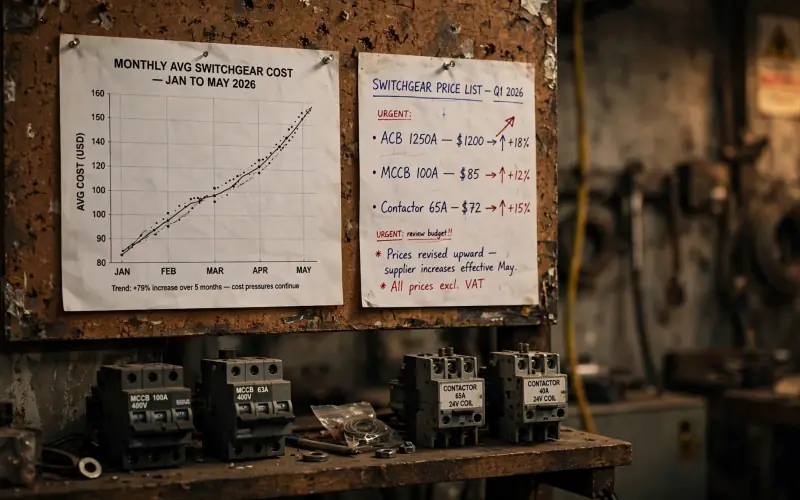
Our guide to the electrical procurement process shows where these steps fit between RFQ and payment, and our post on reading a switchgear quotation explains how a delivery commitment should appear on the quotation itself. Where list prices are moving during a long lead time, see switchgear price increases.
A buffer you hold costs money. A finished panel waiting for one accessory costs more, and in our experience it is the more common of the two.
Questions to ask before you trust a delivery date
- Is this exact part number, suffix included, in stock today, and where?
- Is the date you have given a dispatch date or a delivery date?
- Are all the accessories on this line in stock as well?
- If this is indent, has the factory order been placed, and on what date?
- Does the date depend on my advance payment, and from which day does it count?
- How will you tell me if the date changes, and how early?
A supplier who answers these in writing is making a commitment you can plan against. If the answers are vague, treat the line as indent and plan accordingly.
What to do when a dispatch date slips
Even well-planned orders slip. What you do in the first day after a missed date decides how much of the delay reaches your site.
- Ask for the reason and a revised date in writing. “Delayed at the factory” and “waiting for one accessory” call for different responses.
- Ask for a part dispatch. If most of the order is ready, ship what is ready so that installation can start while the missing line follows.
- Look for the line elsewhere. Another seller, distributor or regional warehouse may hold the exact part number on the shelf.
- Consider an approved equivalent for lines that sit outside any coordination or approval scheme — after the checks in our guide to switchgear brand cross-referencing.
- Record the slip against the supplier and category, so that your next plan uses it.
In our view a supplier who tells you a date will slip, before it does, has earned more trust than one who hits most dates and goes quiet on the rest.
Our position
A lead time is either a measurement or a sales claim, and most of the numbers quoted in this trade are the second. The interval has to be defined before the figure means anything. We start the clock when the order is confirmed, not when the enquiry lands, and we stop it at dispatch rather than delivery, because the transporter is not ours to answer for.
Median and 90th percentile, never the average. An average flatters everyone by burying the tail, and the tail is the only part that breaks a project schedule. Our own dispatch record does not flatter us either: the categories where our numbers are worst are the ones we sell from indent rather than stock, and the honest reading is that a buyer with a fixed handover date should plan those lines to the 90th percentile, or place them with whoever actually holds the stock.
The mistake buyers make is planning to the median, or worse to a promised date, carrying no buffer, then compressing commissioning to absorb the difference. And a line moves at the speed of its slowest accessory: the breaker is ex-stock, the trip unit is not.
Questions buyers ask
What is the typical lead time for an MCCB in India?
It depends on the line, not just the product. Popular three-pole ratings held in stock usually dispatch within days; four-pole versions, high frames, special releases and motor-operated breakers are often made to indent and take weeks. Ask whether your exact part number is ex-stock before you plan.
What does ex-stock mean in an electrical quotation?
Ex-stock means the seller holds the item and can dispatch it without ordering from the manufacturer. It should mean on the shelf today; if a seller will not confirm that in writing, treat the line as indent.
What does indent mean for switchgear?
An indent line is ordered from the manufacturer against your purchase order. Its lead time follows the factory's schedule rather than the seller's shelf, which is why indent quotations often carry deeper discounts and later dates.
Does the brand affect switchgear lead time?
Less than the category and the variant do. Every major brand is quick on its popular ratings and slower on variants, high frames and configured products, and the depth of channel stock in your region matters more than the name on the device.
Why do ACBs take longer to deliver than MCCBs?
Air circuit breakers are usually built to a configuration — frame, release, fixed or drawout, motor operator and accessories — so even makers with good stock assemble many of them to order. They also sell in smaller numbers, so channel stock is thin.
How can I reduce switchgear lead times on a project?
Order indent lines and their accessories first, send a complete specification with the purchase order, release advances promptly, and ask more than one seller about stock on critical lines. Most delay is added before the factory or the godown ever sees the order.
Is lead time counted to dispatch or to delivery?
Sellers usually count to dispatch, because transit is in the transporter's hands. Buyers usually need delivery. Agree which one a date refers to, and add the transit time to your location when you plan.