Verify in this order: check the part number and serial against the manufacturer's own verification channel, inspect the packaging and printed marking, weigh and compare the moulding against a known-genuine unit, and check the supply chain documentation. Any one check can be defeated; the sequence is much harder to defeat.
We will not publish an interception we cannot document, so here is what we can stand behind: our seller onboarding checks PAN, GSTIN and business registration against the entity named on the invoice, which screens out untraceable sellers and does not screen convincing packaging.
Why a counterfeit breaker is a safety problem
A counterfeit circuit breaker can look right, fit right and carry normal load for years. What it may not do is trip on an overload or interrupt a short circuit, which is the only thing a breaker is for. Counterfeits are typically built with less contact material, cheaper thermal elements and weaker arc-quenching than the genuine device, and none of that is visible while the circuit is healthy.
That puts a fake breaker in the same category as a missing earth connection: a hidden defect that turns an ordinary fault into a fire or a shock. The commercial consequences follow. A counterfeit carries no manufacturer's warranty, an insurer investigating a fire will look at the protective devices, and the contractor who installed it carries the liability.
We treat authenticity as a safety check, not a purchasing one, and in our view every buyer of protective devices should do the same.
Check 1: the manufacturer's verification route
Start with the people who made the genuine product. Most major switchgear makers offer some way to confirm that a device or a seller is genuine, although the route differs by brand:
- a list or locator of authorised distributors and dealers on the maker's website;
- a customer care line or email address that will confirm a serial or batch number;
- labels, codes or holograms on newer packaging, checked in the way the maker's own instructions describe.
Use only the verification route published on the manufacturer's official website or in its genuine documentation. A phone number, link or code printed on the suspect carton proves nothing on its own.
For products that must carry the ISI mark — MCBs, RCCBs and PVC-insulated wiring cables among them — there is a second, independent check. The mark is printed with a licence number, in the form CM/L followed by digits, and the licence holder and the products it covers can be checked in the BIS Care app published by the Bureau of Indian Standards. A licence that belongs to another manufacturer, or covers a different product, is a strong warning sign.
In our view this check should come first, before anyone opens a carton: it is the cheapest of the four, and it involves a party the seller does not control.
Check 2: packaging and printed marking
Compare the packaging and the device's marking with a unit you know to be genuine, or with the maker's own product photographs and catalogue. Look for:
- Print quality. Blurred text, uneven colours, misaligned labels and spelling mistakes on cartons and devices.
- Consistency. The same part number, rating and batch or date code on the carton, the device and the documents. A carton for one rating holding a device marked with another is a warning sign.
- Marking content. The ratings, standard number and certification marks the genuine product carries, in the same places, with the ISI mark and licence number where the product requires them.
- Serial and batch numbers. Several devices in one consignment carrying the same serial number, or batch codes that do not follow the maker's usual format.
- Contents. Missing instruction leaflets, test certificates or accessories that the genuine product ships with.
Packaging is the easiest thing to copy, so a pass here proves little on its own. A fail is more informative: genuine makers rarely ship misprinted cartons.
We would not accept a device on packaging alone, and we would not accept one that fails it.
Check 3: physical inspection
If the packaging passes, compare the device itself with a known-genuine unit of the same family and rating. This needs a reference sample, which most sites do not have; a trusted distributor or the manufacturer's local office can often help.
- Weight. Counterfeit breakers are often lighter, because the copper, silver and steel inside have been reduced. A noticeable weight difference against a genuine unit of the same rating is a serious warning.
- Moulding and finish. Rough edges, flash on the moulding, sink marks, or a housing of a different colour or texture.
- Terminals and fixings. Screws and terminals of a different finish, size or quality from the genuine unit.
- Mechanism. A toggle or handle that feels different in travel or force, or an RCCB whose test button does not trip it.
Do not dismantle a device to inspect it: opening it voids any warranty and can make a genuine unit unsafe. Where the device protects something critical and doubt remains, a qualified engineer with the right test equipment can check its trip behaviour against the maker's published characteristics before it is installed.
Physical comparison is the most informative check and the least available. In our view that is a reason to buy critical devices through channels where you never need it.
Check 4: the supply chain documents
Finally, trace where the goods came from. Ask a new supplier for:
- a GST tax invoice from a traceable business, with a valid GSTIN that matches the seller's name;
- evidence of the source — an authorisation letter from the maker, or the invoice trail back to an authorised distributor;
- test certificates and warranty documents where the maker issues them;
- transport documents, such as the e-way bill, that match the invoice.
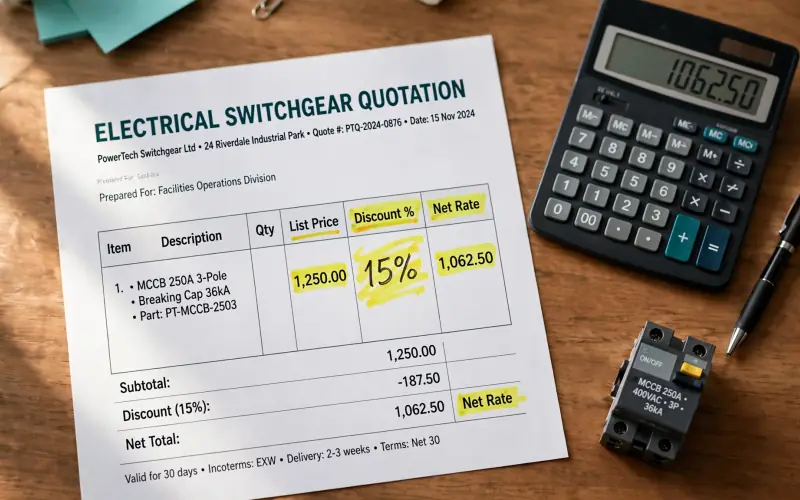
Price is a document too. A quotation well below the market rate on a device that is in demand is information about where that stock came from. Genuine surplus and clearance stock exist, but they come with a story you can verify. Our guide to reading a switchgear quotation explains how to tell a deep discount from a suspiciously low price, and our brand price lists show the maker's list price that any genuine quotation starts from.
In our view an unexplained low price is the most ignored warning in this trade, because it is the one the buyer wants to believe.
What each check can and cannot detect
The four authenticity checks compared
| Check | Detects | Cannot detect | Effort |
|---|---|---|---|
| Manufacturer and BIS verification | Invalid serials, unauthorised sellers, misused ISI licences | A serial copied from a genuine unit; a genuine unit that was tampered with | Low: a call, an email or the BIS Care app |
| Packaging and marking | Poor copies, inconsistent codes and ratings | High-quality copies of genuine packaging | Low: a side-by-side comparison |
| Physical inspection | Reduced materials, poor moulding, a different mechanism | A good copy, when no genuine unit is available to compare | Medium to high: needs a reference sample or tests |
| Supply chain documents | Untraceable sellers and broken invoice trails | Counterfeits passed on by a traceable seller | Medium: needs the supplier's cooperation |
No single row is enough, which is why the sequence matters: a counterfeit has to pass all four checks to reach your panel, and each one closes a gap the others leave open.
Which electrical products are most at risk
Counterfeiters copy what sells fastest and is checked least. In the Indian market that points to a few kinds of product:
- Miniature protective devices. MCBs, RCCBs and RCBOs from widely recognised brands are bought in large numbers, often by contractors on price, and are installed by people who never see the genuine unit beside them.
- Contactors and overload relays. Fast-moving ratings of popular ranges, where a copy can pass a casual look on the shelf.
- MCCBs in common frames. Higher value per unit makes each copy worth more, and a genuine-looking housing hides what is inside.
- Wiring cable. Substandard cable is a quality problem as much as a counterfeit one: a conductor smaller than the size printed on the sheath, or fewer strands than the standard requires, carries less current than the label promises.
For cable, the checks change. Compare the conductor's diameter and strand count with a genuine sample of the same size, check the sheath printing for the ISI mark, licence number and standard, and for a large order have the conductor resistance tested against the limits in IS 8130, the standard for conductors in insulated cables.
We do not name brands or sellers here, and we never will on suspicion alone. The checks work the same way whichever name is on the carton.
A receiving inspection routine for site teams
The four checks only work if someone runs them when the goods arrive. A simple routine at goods receipt is enough for most sites:
- Match every part number and quantity against the purchase order before signing the delivery note.
- Open one carton per batch and compare the device and its marking with the catalogue or a genuine unit.
- Record batch and date codes, and check that they are consistent across the consignment.
- Check ISI licence numbers in the BIS Care app for products that require the mark.
- Hold anything doubtful in a marked quarantine area until it is cleared, rather than in the general store.
In our view the routine matters most on the orders that feel routine: the repeat purchase from a familiar seller, where nobody thinks to look.
Grey-market and refurbished switchgear
Not every doubtful device is a counterfeit. Two other kinds of stock deserve the same caution:
- Grey-market stock is genuine product sold outside the maker's authorised channel — imported for another market, or diverted from a project. It may be genuine and still carry no warranty in India, rated or labelled for a different market, or old stock past its best.
- Refurbished or used devices can be sold as new after cleaning and re-boxing. Worn contacts and aged mechanisms are not visible from the outside.
The supply chain check catches most of both: an authorised channel can show where a device came from, and a grey-market source usually cannot. If a seller cannot tell you how the stock reached them, treat it as unverified.
What to do if a part fails a check
- Do not install it. Quarantine the device and anything else from the same consignment.
- Record everything. Photograph the device, its marking and the packaging, and keep the invoice and transport documents.
- Tell the seller in writing, with the evidence, and ask for their source.
- Report it to the manufacturer through its official channel; makers take counterfeit reports seriously and can confirm whether a serial is theirs.
- Report misuse of the ISI mark to the Bureau of Indian Standards, which accepts complaints through the BIS Care app.
Your remedies against the seller depend on your purchase terms and the law of contract and sale of goods. For a large consignment, take legal advice before returning the goods, so that the evidence stays with you.
What marketplace seller verification does and does not prove
Every seller on VendorStocks is verified on documents: PAN, GSTIN and business registration, checked against the entity named on the invoice. That establishes that the seller is a real, traceable, tax-registered business you can hold to account.
It does not establish that every carton that seller ships is genuine. No document check can. That is why the four checks above apply to everything you receive, from us or from anyone else, and why, for devices that are the last line of protection on a board, we recommend buying through the brand's authorised channel even when that channel is not us.
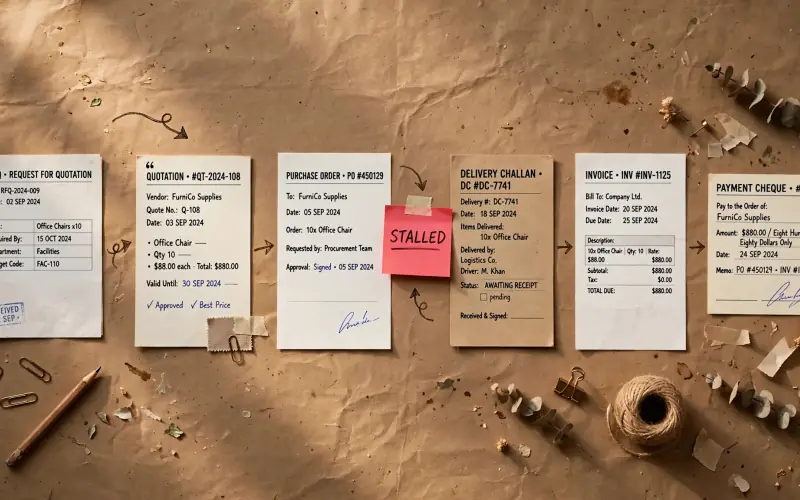
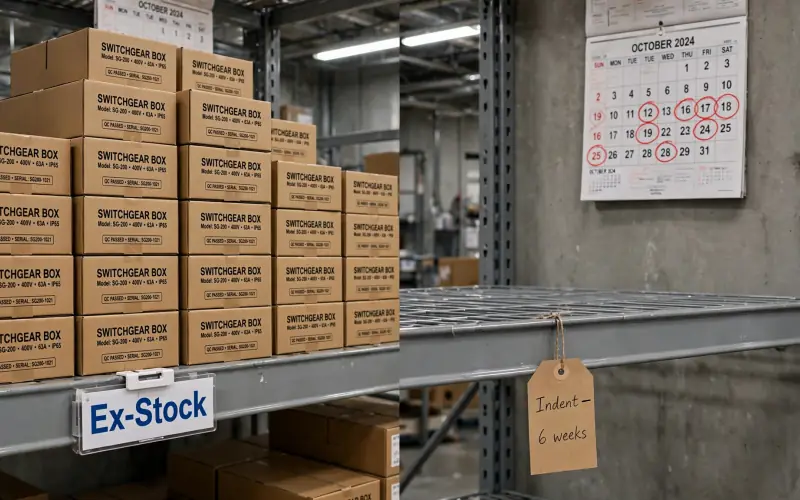
For how a purchase moves from RFQ to delivery and inspection, see our guide to the electrical procurement process. For how delivery timing affects when you can inspect, see switchgear lead times, and for the specification errors that are often mistaken for counterfeits, the most common switchgear ordering errors.
Our position
A counterfeit breaker is not a commercial problem. It carries load normally for years and then fails to interrupt on the day interruption is the point. That puts it with a missing earth, not with a bad bargain. Warranty and insurance go with it.
No single check is enough, and we will not pretend otherwise. Marking and packaging can be reproduced, and a moulding comparison needs a known-genuine unit of the same family on the bench, which most sites lack. So run the manufacturer's verification route first, then packaging, then the physical comparison, then the invoice trail to an authorised channel. The signal buyers keep ignoring is price: a quote well under market on a wanted device is information about where that stock came from.
Our side of this is narrower than buyers assume. Our vendor verification is document-based — PAN, GSTIN, business registration — and it establishes that a seller is a real, traceable, taxable entity. It does not certify that any individual carton is genuine, and claiming otherwise would make the rest worthless. Where the device is the last line of protection on a board, buy through the brand's authorised channel, even when that channel is not us.
Questions buyers ask
How can I tell if an MCB is fake?
Check the ISI licence number in the BIS Care app, compare the printing, marking and batch codes with a genuine unit, compare the weight — counterfeits are often lighter — and confirm that the seller can show an invoice trail to an authorised distributor.
How do I verify an ISI mark?
Note the licence number printed with the mark, in the form CM/L followed by digits, and check it in the BIS Care app. The licence should belong to the maker named on the product and cover that product.
Does an ISI mark prove that a product is genuine?
Not on its own, because the mark itself can be copied. What proves it is the licence behind the mark: check that the CM/L number belongs to the maker named on the product and covers that product, then run the other checks.
How can I check whether wiring cable is genuine?
Compare the conductor's diameter and strand count with a genuine sample of the same size, check the sheath printing and ISI licence number, and for large orders have the conductor resistance tested against the limits in IS 8130.
Is a cheap MCCB from an unknown seller always fake?
Not always — surplus and clearance stock exist. But a price well below market on a device in demand should trigger every check in this guide, and a genuine seller will be able to explain where the stock came from.
Does buying on a verified marketplace guarantee genuine switchgear?
No. Seller verification proves that the business is real and traceable; it does not certify individual cartons. Run the checks on what arrives, and buy critical devices through the brand's authorised channel.
Who should I report counterfeit switchgear to?
The manufacturer, through the contact route on its official website, and the Bureau of Indian Standards if the product carries a misused ISI mark. Tell the seller in writing as well, and keep the device and its packaging as evidence.